
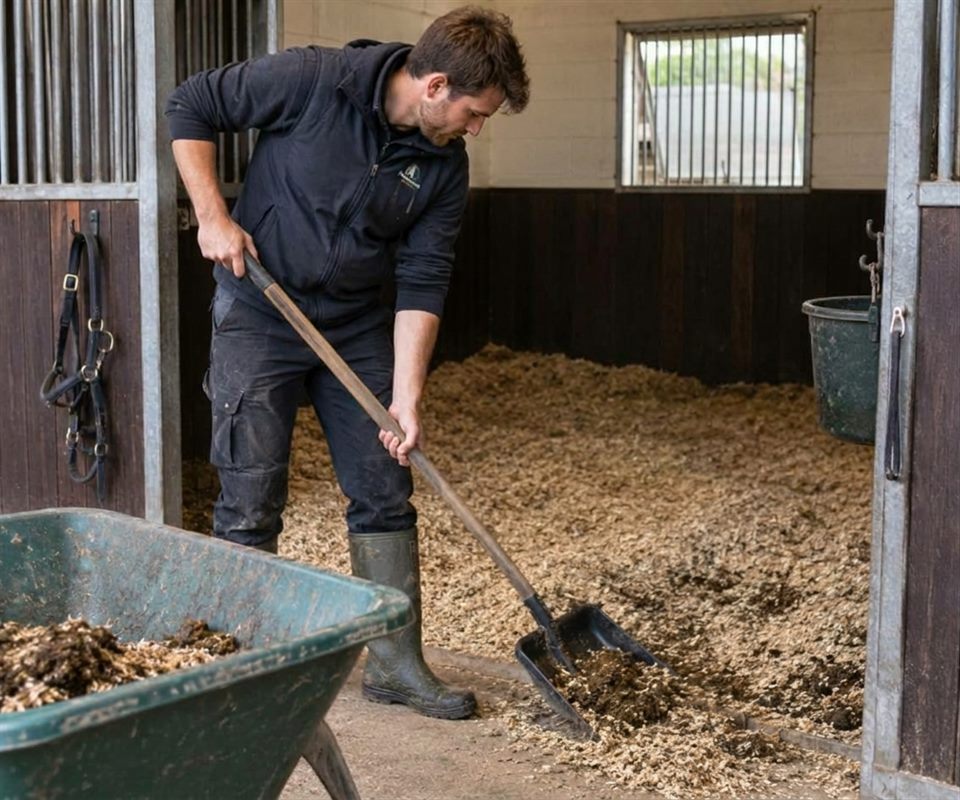
- Bedding should be non-toxic, free of mould and excessive dust, and keep the bed dry. It should cover the whole floor.
- Shavings, wood fibre, flax and hemp, paper and cardboard are all lower in dust than ordinary straw, which can carry dust and mould spores.
- Rubber mats still need bedding on top to soak up urine, and must be lifted and cleaned underneath at least once a month.
- The BHS strongly recommends a full muck-out every day. Deep litter saves time and money but is the worst for your horse's breathing.
- Take your horse out of the stable while you muck out, and let the dust settle before it goes back in.
A stabled horse stands, rests and lies down on its bed for many hours a day, and breathes the air just above it. Good bedding and regular mucking out keep it comfortable, protect its feet and legs, and keep dust and ammonia away from its airways.
What bedding is for
The code of practice says every stable needs enough suitable bedding to give warmth, protect against injury and let the horse lie down in comfort. It should be non-toxic and free of mould and excessive dust, and it should either drain well or absorb enough to keep the bed dry and the air fresh.
The British Horse Society adds what to look for:
- Low dust and no mould spores, especially for horses or people with breathing problems.
- Good absorption. Bedding that soaks up urine poorly lets ammonia build up in the stable, which can harm the airways.
- Easy to muck out, with droppings easy to separate from the clean bed.
- Support. The bed should support the feet when the horse stands and its whole body when it lies down, helping it get up safely. High banks and a thick bed help reduce injury if a horse gets cast (stuck lying down and unable to get up).
- Safe to eat, and not irritating to the skin.
The BHS says bedding or matting should cover the whole floor, especially near the door, so the horse isn't standing on bare concrete.
Bedding types compared
The BHS describes the main types:
| Bedding | Good points | Drawbacks |
|---|---|---|
| Straw | Easy to find, fairly cheap and easy to use. Wheat straw, the most common, makes a warm bed that drains freely | Quality varies, and it can carry dust and mould spores. Rarely odour-free, with a big muck heap. Wheat is the dustiest straw; barley straw's prickly ears can irritate skin; horses are more likely to eat oat straw. Not ideal for horses with breathing problems or that eat their bed |
| Wood shavings | Dust-extracted shavings are low in dust and support the feet. Wrapped bales are easy to store. Often used for horses with breathing problems or that eat other beds | Dust varies a lot between products. Cheap sawmill waste can contain sharp splinters and isn't suitable |
| Shredded wood fibre | Made from recycled white wood. Low dust, absorbent, keeps the surface dry and moves less underfoot. Very little waste, so one of the smallest muck heaps | — |
| Flax and hemp | Low dust; easy to store in heavy plastic bags | Often more expensive. A few horses eat it, and it's hard to digest |
| Paper | Low dust, and horses are unlikely to eat it. One of the cheaper beds | Long strips stick together and are harder to muck out. Ink can stain a pale coat. Soggy when wet |
| Cardboard | Low dust. Wet patches clump, so they're easy to lift out | Moves about and can leave bare patches, and it's hard to separate from droppings |
Chopped, treated straw is also sold in wrapped bales. The BHS says its quality is more consistent and it's easier to store, but it can cost more.
Rubber matting gives the feet and legs excellent support and better grip than concrete, and means using less bedding, which saves time and shrinks the muck heap. It costs a lot at first. The BHS strongly advises a good layer of bedding on top of mats, to soak up urine and hold droppings, and does not endorse mats without bedding: floors get wet, rugs and horses get dirty, and many horses don't like to urinate on a hard surface. The code of practice also says to add some bedding to absorb urine. Lift the mats and clean underneath at least once a month, says the BHS, and more often in hot weather, to stop ammonia and dirty bedding building up.
Straw and weight. The BHS notes that straw beds have been found to increase how long horses spend lying down and foraging, but a horse on a weight-loss diet may eat too much of its straw bed.
Mucking out
The BHS says regular mucking out of the whole stable is fundamental to your horse's health. It describes three ways of doing it:
| Method | What you do | Trade-offs |
|---|---|---|
| Full muck-out | Muck out the whole stable every day, rotating the banks | Takes longest, but gives the best environment. The BHS strongly recommends it |
| Part muck-out | Remove droppings every day during the week, adding fresh bedding as needed, and do a full muck-out at weekends | A compromise when time is short |
| Deep litter | Remove droppings and add fresh bedding on top, emptying and cleaning the stable completely from time to time | Cheapest in time and money, but the least suitable for breathing, with more ammonia than a daily full muck-out. Don't let the bed get too deep |
Turn the banks round regularly so they don't go mouldy and dusty. Pick out your horse's feet every day, ideally twice: a clean, dry bed helps prevent thrush.
Keeping dust down
The BHS's equine asthma advice is to:
- take your horse out of the stable while you muck out, which raises a lot of dust, and let the dust settle before it goes back in
- choose low-dust bedding, such as dust-extracted shavings, paper, cardboard or pelleted straw
- muck out every day so ammonia doesn't build up, and make sure the floor drains
- lift, hose and disinfect rubber mats regularly
- sweep the yard every day and dust the stable fittings to clear cobwebs
- store forage and bedding away from the stable, somewhere dry and sheltered
- groom in an open, airy place, not in the stable
It adds that deep litter is the least suitable bed for a horse with breathing problems. Bransby Horses also advises daily mucking out, and airing the stable, to stop ammonia building up.
Coughing, a runny nose, tiring easily or struggling to breathe can be signs of equine asthma, which the BHS says affects 14% of horses in the UK in its severe form. Speak to your vet, who can confirm it and advise on changes to your horse's stable and forage.
This guide cannot diagnose your horse. If in doubt, call.
Storing bedding and the muck heap
Wrapped bedding can be kept outside or under cover, but loose bedding such as straw needs a cool, dry place, like a weatherproof barn. The BHS's fire advice is to store bedding, hay and straw well away from the stables, and to site the muck heap downwind and at least 15 metres from them. Bransby Horses adds that removing droppings often, and keeping the muck heap away from where horses live, helps deter flies.
Most bedding rots down, but some types take longer than others and produce more waste. Some yards insist on a particular bedding, and some have to pay to have the muck heap taken away. The BHS points to the Environment Agency, Defra and, in Scotland, SEPA for the rules on muck heaps.
Buying bedding. Supply and price depend on the season, the harvest and local suppliers, and costs can rise when supplies are short. Buying in bulk can help on a large yard. On livery, bedding may be included, though it can be hard to change product.
Sources
- Code of practice for the welfare of horses, ponies, donkeys and their hybrids — Department for Environment, Food & Rural Affairs (accessed 9 October 2026)
- Stable management and bedding — The British Horse Society (accessed 9 October 2026)
- Bedding types — The British Horse Society (accessed 9 October 2026)
- Horse stables: safety, design and size — The British Horse Society (accessed 9 October 2026)
- Respiratory health: equine asthma — The British Horse Society (accessed 9 October 2026)
- Stable fires — The British Horse Society (accessed 9 October 2026)
- Winter management — Bransby Horses (accessed 9 October 2026)
- Summer management — Bransby Horses (accessed 9 October 2026)