
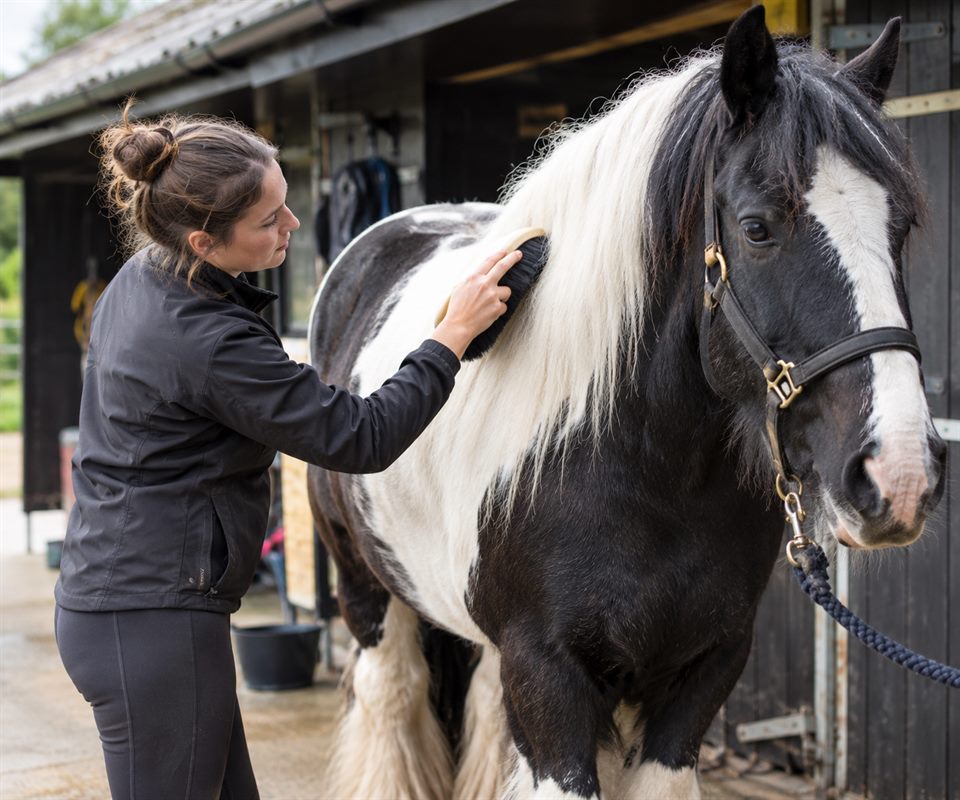
- Check horses at grass at least once a day, and preferably more often. Check stabled horses at least twice a day.
- Every horse needs continuous access to clean, fresh water and almost constant access to forage.
- Learn your horse's normal temperature, pulse and breathing rate, so you can spot changes early.
- Care needs vary with type: hardy native ponies, heavy horses with feathered legs and finer-coated breeds each need something different.
- If anything seems wrong, call your vet. Acting early matters.
Your legal duty
In the UK, horses are protected by the Animal Welfare Act. If you own or are responsible for a horse, you have a duty to look after its basic welfare:
- provide a suitable place to live and a suitable diet
- protect it from pain, injury, suffering and disease
- make sure it can behave normally and naturally
- keep records of all medical treatment
- keep its vaccinations up to date, under the advice of a vet
- register it with a veterinary practice and a registered farrier
Every horse must also have a valid passport and a microchip. The government's code of practice for horse welfare explains how to meet these duties, and much of this guide follows it.
How often to check your horse
The code of practice says horses at grass should be inspected at least once a day, and preferably more often. Stabled or group-housed horses should be inspected at least twice a day.
Each time, look closely at the horse's gait, demeanour, feet, body condition and appetite, so early signs of disease, injury or parasites are spotted and treated quickly. Do a closer, hands-on examination at regular intervals, ideally every day. This finds problems you can't see from a distance, such as skin conditions or a change in body condition.
The daily check
World Horse Welfare and the code of practice suggest checking the following every day:
- Soundness: watch the horse move, and check it isn't lame.
- Eyes: check both. Discharge from an eye can be a sign of disease.
- Body and legs: run your hands over them for injuries, lumps, swellings or heat. Doing this while grooming and picking out the feet is easiest.
- Eating and drinking: check the horse is eating and drinking normally.
- Droppings and urine: check both look normal.
- Feet: pick out and examine the feet of field-kept horses for signs of discomfort, wounds, loose shoes, packed-in material or anything unusual. Stabled horses should have their feet picked out when leaving the stable, and working horses before and after exercise.
- Rugs: if your horse wears one, take it off regularly, ideally every day, to check for rubbing or soreness and to see the horse's body condition. Refit or change it if needed.
- Behaviour: know your horse's usual behaviour, and treat any change as a possible sign that something is wrong with its health or environment.
Groom regularly to keep the coat clean and to spot wounds, parasites and rubs from rugs or tack. How often depends on how your horse is kept and on its coat type. See grooming and coat care.
Know what is normal
Knowing your horse's normal temperature, pulse and breathing rate helps you spot illness early. World Horse Welfare gives these normal ranges for a healthy adult horse at rest:
| Measure | Normal range |
|---|---|
| Temperature | 37.5–38.5 °C |
| Pulse | 36–42 beats per minute |
| Breathing (respiration) | 8–12 breaths per minute |
Horses vary, so learn your own horse's normal values: record each one every day for a week while the horse stands calmly at rest, then take the average.
Water and forage
Water. Every horse must have continuous access to clean, fresh water. Where that isn't practical, offer plenty of clean water often and regularly. Streams and other natural sources may be contaminated, so you may need another supply. Take extra care in hot and icy weather. Break ice regularly, and check troughs every day in freezing weather. Bransby Horses notes that horses often drink more in winter, when they eat more dry forage such as hay.
Forage. Horses are grazers that naturally eat little and often. Their diet should be mostly fibre: grass, hay, haylage or a hay replacer. The code of practice says horses should have almost constant access to forage when they aren't working. Stabled horses should be given forage at regular intervals, to mimic natural grazing. Diets too low in fibre can cause physical and psychological problems.
Change feed gradually. Sudden changes to the diet, including more feed or a different hay, can cause colic and diarrhoea. A sudden change in appetite or weight can be a sign of illness.
Field, shelter and stable
- Fencing: check it every day, so the field is secure and nothing could cause an escape or an injury.
- Water supply: check automatic troughs regularly for leaks, and that they are filling in cold weather.
- Poisonous plants: look for and remove sycamore seeds and seedlings and acorns. Fence off any areas under these trees.
- Shelter: horses living out need shelter from the prevailing wind, summer sun and flies. It can be natural, like trees or hedges, or a field shelter.
- Stables: stables should be well ventilated but free of draughts, big enough for the horse, and kept clean so ammonia doesn't build up and harm the airways. At a minimum, a horse must be able to lie down, get up and turn around in comfort.
Company and turnout
Horses are herd animals and should be able to socialise with other horses. Keeping a horse alone can harm it psychologically. Other animals can provide company if necessary, but the company of other horses is far better. Every stabled horse, except one on box rest for veterinary reasons, benefits from daily turnout to graze and socialise. Turnout may also reduce the risk of stereotypic behaviours such as weaving and crib-biting. If turnout isn't possible, stabled horses should be exercised every day.
Signs your horse may be unwell
The code of practice lists signs that may mean poor health:
- a change in appetite or drinking
- a change in droppings or urine
- a change in demeanour or behaviour
- a change in weight
- signs of pain or discomfort, such as facial tension, reluctance to move, pawing, rolling, faster breathing or sweating
- reluctance or inability to stand
- any injury or lameness, including puncture wounds
- signs of disease, such as discharge from the eyes, ears or nose, coughing or difficulty breathing
Contact your vet if you think anything is wrong with your horse. Keep your vet's details, including out-of-hours numbers, where everyone caring for your horse can find them. Keep the horse's passport to hand: by law it must be easily accessible, and some treatments may not be possible without it.
This guide cannot diagnose your horse. If in doubt, call.
Beyond the daily routine
Daily checks sit alongside regular care, which World Horse Welfare summarises as follows:
- Farrier: hooves trimmed or shod by a qualified, registered farrier, on average every 6–8 weeks. Some horses need visits more often.
- Teeth: checked by a qualified equine dental technician or a vet at least once a year.
- Vaccinations: equine influenza (flu) and tetanus as part of an annual health plan. Competition horses may need flu vaccinations every 6 months, depending on the governing body's rules.
- Worming: base decisions on faecal egg counts and other tests, with a worm control plan from your vet or a qualified adviser. Regular poo-picking helps prevent infection.
- Saddle and bridle: horses in ridden work should have their tack checked by a qualified fitter every 6 months, or more often if they are changing shape.
- Weight: monitor it with regular fat scoring and a weigh tape or weighbridge. Horses that are overweight or underweight are more likely to have other health problems.
Care by type
The basics above apply to every horse, but the code of practice is clear that diet and management should suit the individual horse: its age, type, weight, condition, health and work. Some differences follow breed type:
- Native ponies and cobs: hardy, thick-coated and often able to live out all year, but prone to weight gain, equine metabolic syndrome and laminitis. Weight management is the main daily task.
- Heavy horses: big horses with feathered legs. Feather mites, mud fever and the space a large horse needs are the main extra considerations.
- Finer-coated horses: Thoroughbreds, Arabs and warmbloods are less hardy. They are more likely to struggle in cold, wet weather, and may need stabling or extra shelter and a rug.
To find out which type a breed is, see the Breeds A–Z.
Sources
- Code of practice for the welfare of horses, ponies, donkeys and their hybrids (2018) — Department for Environment, Food & Rural Affairs (accessed 7 October 2026)
- Keeping horses: looking after horses — Department for Environment, Food & Rural Affairs (accessed 7 October 2026)
- Horse health essentials — World Horse Welfare (accessed 7 October 2026)
- Types of rugs and rugging a horse — The British Horse Society (accessed 7 October 2026)
- Winter Management — Bransby Horses (accessed 7 October 2026)