
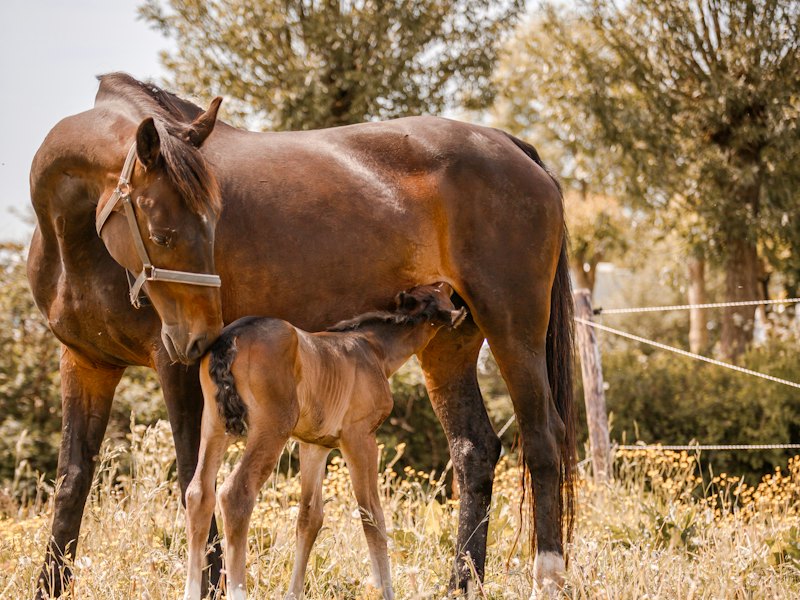
- Think hard before breeding: Defra's code of practice asks owners to consider whether they could buy or rehome a youngster instead, and what the foal's future will realistically be.
- Pregnancy lasts on average 335–340 days, but a healthy foal can arrive weeks either side of that.
- Most mares foal quickly and without trouble, but problems are emergencies: once the waters break, the foal should be born within about 30 minutes.
- Remember 1-2-3: the foal should stand within 1 hour and suckle within 2, and the mare should pass the placenta within 3.
- Have a vet check the mare, foal and placenta within the first 24 hours.
Before you breed
Breeding a foal can be a wonderful experience, but it is a long commitment. Defra's code of practice for horse welfare asks anyone thinking of breeding from their mare to consider:
- Is your mare a suitable candidate for breeding?
- Has the stallion been inspected, and is he free from heritable conditions?
- Could you buy or rehome a youngster instead of breeding a foal?
- Are you ready for the time and cost? Caring for a young foal is expensive and takes a great deal of time, and there's no guarantee the foal will grow up into the horse you want.
- What is the foal's realistic future? Will you keep it? What will you do if it doesn't suit you, and is there a realistic market for it?
The code notes that overpopulation of horses was a problem in the UK when it was published. World Horse Welfare makes a similar point about retired sport horses: breeding from them should only be considered after careful thought and veterinary advice, because too many mares produce foals that will never excel and often can't be rehomed.
Pregnancy
On average, a mare is pregnant for 335 to 340 days, about 11 months. The normal range is wide: the Royal (Dick) School of Veterinary Studies in Edinburgh gives 320 to 370 days, and the University of Liverpool's equine practice roughly 320 to 360.
Scans. The Royal Veterinary College describes a typical schedule after insemination: a scan at 14–16 days to confirm pregnancy and check for twins, another at 28–30 days to check for a heartbeat, and usually one at about 45 days. Around 10% of pregnant mares show signs of being in season; the RVC says this is normal for them, but a scan or blood test is recommended to check the pregnancy hasn't been lost.
Feeding. Until the ninth month, the RVC says a pregnant mare can be fed according to her condition and work, like any other adult horse. From month nine she needs extra protein and calories, often from a stud or youngstock mix. Make any change slowly, over seven days.
Health care. Keep up routine care, with a few additions:
- Vaccinations. The RVC recommends a flu and tetanus booster in the last six weeks of pregnancy, so that the mare's first milk (colostrum) carries antibodies to protect the foal; the Liverpool practice advises one a month before foaling. Both also describe vaccinating against equine herpes virus at months 5, 7 and 9.
- Equine herpes virus can cause abortion. Defra's code notes that it is common in young horses, so pregnant mares should be kept apart from young horses.
- Worming continues, using only wormers whose label says they are safe in pregnancy.
- Dental checks continue as usual; the RVC notes that sedation is very safe for pregnant mares.
Behaviour. Many mares settle happily into life as a broodmare. Occasionally, the RVC notes, mares become aggressive for periods during pregnancy, because of the hormones the foal produces.
Getting ready to foal
Many owners send their mare to a stud to foal, where experienced staff look after her. If she foals at home, the University of Liverpool advises letting your vet know her due date, so they're ready to respond quickly if there's a problem.
- Move her early. The Dick Vet suggests moving the mare to where she'll foal 2 to 3 weeks before her due date, because sudden changes may delay foaling.
- Give her room. Defra's code gives 4.25 m by 4.25 m (14 ft by 14 ft) as the size of a foaling box for a horse. In warm weather, many mares foal in a grassy paddock.
- Keep her moving. Shutting a mare in a stable for long periods just before foaling can make impaction colic more likely; let her exercise.
- Caslick's operation. If your mare has had a Caslick's operation, in which the lips of the vulva are partly stitched together, they must be opened at least 14–28 days before foaling.
Signs that foaling is near
The Dick Vet describes the classic signs:
| When | Sign |
|---|---|
| 2–6 weeks before | The udder starts to develop |
| 4–6 days before | Milk lets down into the teats, which fill out |
| 1–2 days before | "Waxing up": a yellow, waxy crust forms on the ends of the teats; some mares drip milk |
The University of Liverpool's equine practice adds that the muscles and ligaments around the pelvis may relax, and the vulva may look longer.
Foaling
Foaling happens in three stages.
| Stage | What happens | How long |
|---|---|---|
| 1. Getting ready | Contractions begin and the foal moves into position. The mare is restless: pawing, getting up and down, sweating, passing urine often, perhaps calling out or showing mild signs of colic | 30 minutes to a few hours (RVC); 1 to 4 hours (Dick Vet) |
| 2. Birth | The waters break and strong contractions begin, usually with the mare lying down. The front feet appear first, followed by the nose | Within about 30 minutes of the waters breaking, often much quicker |
| 3. Afterbirth | The mare passes the placenta | Within 3 hours |
Mares give birth "explosively", as the Dick Vet puts it: it can all be over in about fifteen minutes. More than 95% of mares foal without complications. But when something does go wrong, it is a serious emergency for both mare and foal, so act fast:
- A normal foal arrives in a whitish membrane. If a red membrane appears instead, a "red bag delivery", the foal is at risk: the University of Liverpool advises breaking the membrane by hand straight away.
- Call your vet immediately if the foal is in an abnormal position, or isn't born after 15 minutes of the mare pushing.
- Keep the placenta in a clean bucket so your vet can check it is complete. A retained placenta is a veterinary emergency that can cause infection and laminitis.
The first hours: remember 1-2-3
The Royal Veterinary College's guidelines for a newborn foal:
- 1 hour: the foal should be standing.
- 2 hours: it should be suckling from the mare.
- 3 hours: the mare should have passed the placenta.
The RVC adds that the foal should pass its first droppings, called meconium, within 4 hours. If any of these hasn't happened, the RVC says you need an urgent vet visit.
Colostrum is vital. A foal is born with no antibodies of its own, and in horses they don't cross the placenta: the only way the foal receives its mother's immunity is through colostrum. The Liverpool practice explains that the foal can't absorb it after the first 6–12 hours, and the Dick Vet says it should drink at least 1–2 litres of milk in its first 8 hours. A blood test (an IgG test) taken at 18–24 hours shows whether it got enough.
Care for the navel. Dip the stump of the umbilical cord in an iodine or chlorhexidine solution, and repeat several times over the first few days, to stop bacteria getting in.
Vet check. Have your vet examine the mare, foal and placenta within the first 24 hours.
Call your vet straight away if:
- foaling is taking longer than expected: the mare has been pushing for 15 minutes, or it is over 30 minutes since the waters broke
- the foal is coming in an abnormal position
- the foal isn't responsive, hasn't stood within 1 hour or hasn't suckled within 2
- the placenta hasn't come away within 3 hours
- the mare can't stand, seems dull or off her food, is bleeding heavily, or is frightened of or aggressive towards her foal
This guide cannot diagnose your horse. If in doubt, call.
What comes next, from handling to weaning, is in Foals and young horses.
Sources
- Code of practice for the welfare of horses, ponies, donkeys and their hybrids (2018) — Department for Environment, Food & Rural Affairs (accessed 8 October 2026)
- Pregnancy support and FAQs — Royal Veterinary College, University of London (accessed 8 October 2026)
- Foaling support and foal checks — Royal Veterinary College, University of London (accessed 8 October 2026)
- Fact sheet: the foaling mare — Royal (Dick) School of Veterinary Studies, University of Edinburgh (accessed 8 October 2026)
- Mare and foal — University of Liverpool School of Veterinary Science (accessed 8 October 2026)
- Caring for your mare and foal (responsible horse owner booklet) — University of Liverpool School of Veterinary Science (accessed 8 October 2026)
- Life after competition — World Horse Welfare (accessed 8 October 2026)